
Episode 62 · Season 1
Signal, Sort, Store: The Discipline Behind Smart Agents
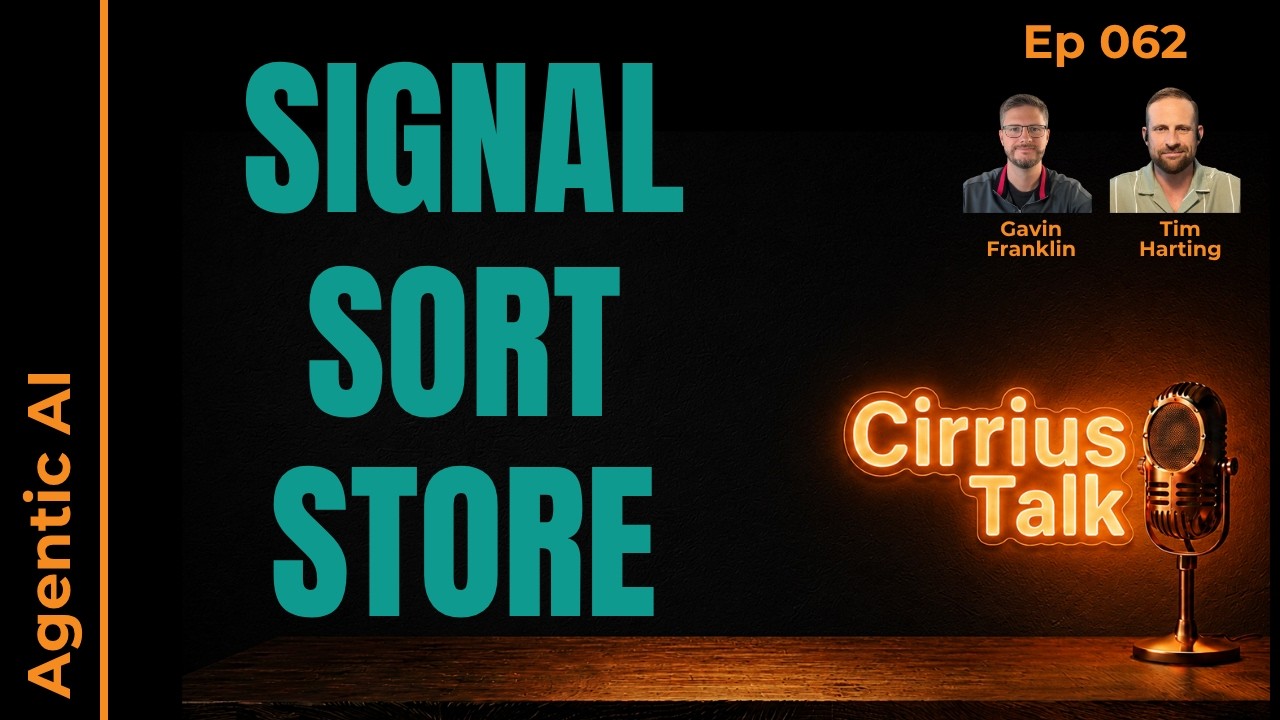
You have dreamed up a dozen things an AI agent could do for you, but the moment you open it, it feels like a stranger who has never met you. In this kickoff to the agentic operating system mini-series, Gavin Franklin and Tim Harting break down the first pillar – the signal layer and context management – so your agent starts acting like it actually knows you and your work.
What you’ll learn:
- What a “signal” really is, and the three ways to pull one: structured skills, on-demand chat, and scheduled runs
- The four tiers every incoming signal should sort into: transient, durable fact, project, and archive
- How the Common Operating Picture (borrowed from the military) gives an agent and a human the same current-state view
- Where to keep humans in the loop: what an agent may propose versus what it can write freely
- Why you should treat every wrong answer as a bug in the system, not a one-off correction
Who it’s for:
Engineering leaders, architects, and AI-curious operators who want agents that stay useful past week two – and past month six.
Guest + credibility:
Tim Harting, COO of Cirrius Solutions, and Gavin Franklin, Head of Custom Development, build and deploy agentic systems at Cirrius, both internally and for customers. Everything here is drawn from operating systems they have actually rolled out across teams using harnesses like Claude Code, Codex, and Cursor.
Primary CTA:
In the middle of building your own agentic operating system and hitting walls? Reach out and let’s talk it through. Follow the show for more Cirrius Talk: Agentic AI episodes.
Recommended Links & Resources
Any Questions: Reach out to us at CirriusTalk@cirriussolutions.com
#AgenticAI #ContextEngineering #AIAgents #ClaudeCode #KnowledgeManagement #AIStrategy
We cover
- Understanding Signal Layers and Context
- Collecting and Organizing Signals
- The Importance of Context in Agentic Systems
- Memory Structures and Project Management
- Common Operating Picture: A Framework for Clarity
- Scalability and Shareability of Context
Chapters
- 0:32Introduction to Agentic AI and Context Management
- 2:42Understanding Signal Layers and Context
- 5:22Collecting and Organizing Signals
- 7:41The Importance of Context in Agentic Systems
- 10:19Memory Structures and Project Management
- 13:08Common Operating Picture: A Framework for Clarity
- 15:45Scalability and Shareability of Context
- 18:28Balancing Agent Autonomy and Human Oversight
- 21:00Session Management and Self-Learning Systems
- 23:48External vs. Local Memory in Agentic Systems
- 26:27Final Thoughts on Building an Effective Agentic OS
Resources and downloads
The artifacts Greg’s team built for this episode, free to download.
Context Engineering for AI Agents: Signals, Memory & the COP
Explores how an agentic OS handles memory, showing how information is stored, organized, and retrieved to support smarter behavior, and why the memory layer matters for building more capable AI agents.
Related episodes
 Agentic AIAgentic OS Explained: 4 Pillars That Keep Your AI Agent Sharp
 Agentic AISkills vs Commands: When to Use Each in Your Agentic OS
 Agentic AIAI Agent Strategy: 7 Deliverables to Lock In Before Development
 The Military MinuteAir Force Linguist to Salesforce Admin: Meagan Kut’s PathMeagan Kut
 Salesforce at ScaleHayley Tuller – The Map, the Mess, and the Mission: Scaling Salesforce the Right WayHayley Tuller
Talk to us about AI agents
Keep going: See how we build AI agents for real businesses, Talk to us about a custom AI agent, More from the Cirrius blog