
Episode 83 · Season 1
Why Do 1,200 Companies Hire From One Microsoft Veteran Program?
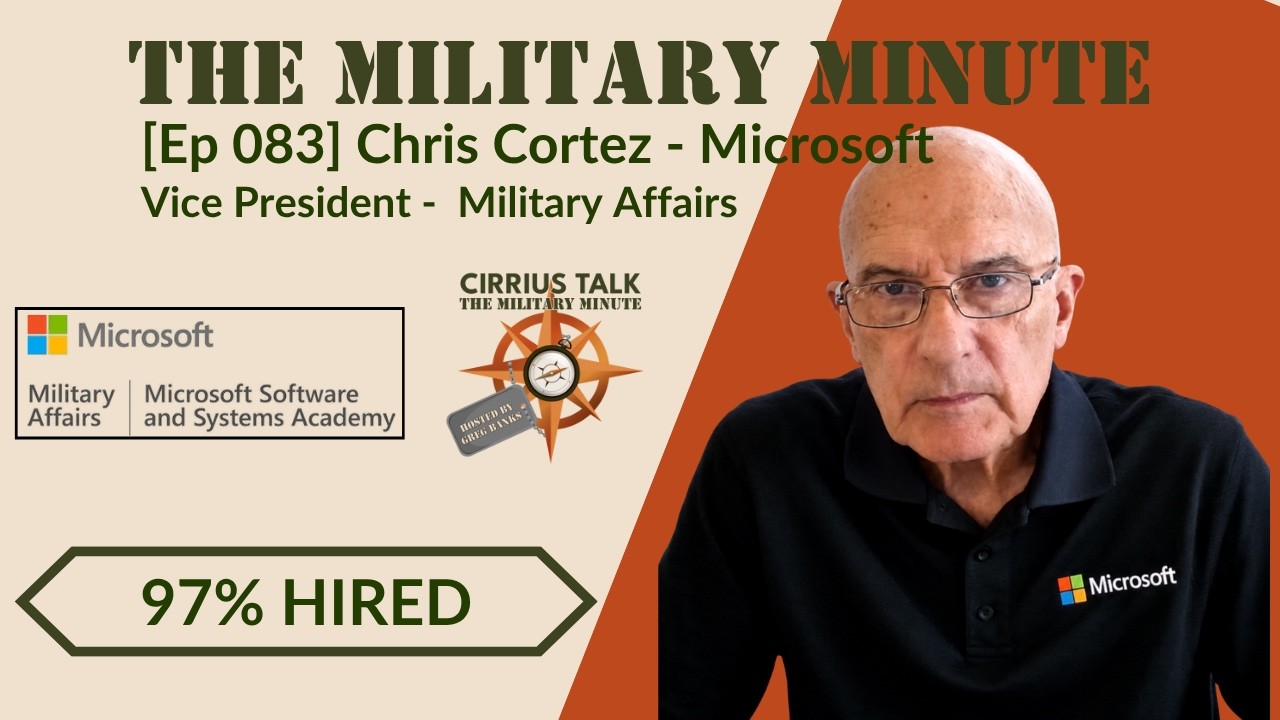
Most transitioning service members hit the same wall: how does what you did in uniform translate to a career in tech? Retired Major General Chris Cortez, Vice President of Military Affairs at Microsoft, joins Greg Banks to break down the Microsoft Software and Systems Academy (MSSA), the 17-week program that has carried thousands of veterans and military spouses into technology careers at no cost to the participant. Do not miss the epilogue which include updates to the MSSA program.
What you’ll learn:
- How MSSA works: 120 days of fully virtual training in server and cloud administration, cybersecurity operations, or cloud application development, split 80/20 between hardcore technical instruction and Friday professional development
- What it takes to get in: an application, prerequisite courses, commanding officer approval for those still serving, and an interview, with Microsoft picking up the full cost
- Why Chris tells every transitioning service member it’s a marathon, not a sprint, and why 1,200 companies keep coming back to hire from a program with 4,453 graduates, a 94% graduation rate, and a 97% employment rate
- Microsoft’s two new accelerated pathways: the Military Datacenter Pathway, about 60 to 90 days online for datacenter careers, and the MSSA Cleared Talent Accelerator, a 90-day program for TS/SCI-cleared service members and veterans. Details in the Epilogue
Who it’s for:
Transitioning active duty service members, reservists, National Guard members, veterans, and military spouses weighing a move into tech. It is equally for employers and leaders wondering what a serious military affairs initiative can grow into.
Guest + credibility:
Chris Cortez is a retired two-star Major General, US Marine Corps, and Vice President of Military Affairs at Microsoft, the division he helped stand up in 2014 after joining the company in 2006. He has guided MSSA from its 2013 pilot of 22 participants at Joint Base Lewis-McChord to roughly 22 cohorts and 330 participants a year, supported by 707 Microsoft volunteer mentors.
Primary CTA:
Listen now, then share this episode with a service member, veteran, or military spouse who is ready to plan their next mission in tech.
Recommended Links & Resources:
Microsoft Software and Systems Academy (MSSA)
Microsoft Military Datacenter Pathway
MSSA Cleared Talent Accelerator
Why Microsoft continues to deepen military investment
Cirrius Solutions – Use this link to find a curated list of resources we promote based on first-hand experience.
Any Questions: Reach out to us at CirriusTalk@cirriussolutions.com
We cover
- Transitioning from Military to Civilian Life
- The Microsoft Software and Systems Academy (MSSA)
- Adapting to Virtual Learning During COVID-19
- Criteria for Enrollment in MSSA
- Success Stories from MSSA Graduates
- Building Partnerships with Companies
Chapters
- 0:50Introduction to Military Transition Programs
- 1:01Introduction to Chris Cortez and His Background
- 2:51Transitioning from Military to Civilian Life
- 8:04The Microsoft Software and Systems Academy (MSSA)
- 15:23Adapting to Virtual Learning During COVID-19
- 16:52Criteria for Enrollment in MSSA
- 20:59Success Stories from MSSA Graduates
- 25:57Building Partnerships with Companies
- 28:34Advice for Companies Supporting Veterans
- 31:52Epilogue – Introduction to Microsoft’s New Pathways
- 33:52Recap and follow-up links
Chris Cortez
VP, Microsoft Military Affairs at Microsoft
Related episodes
 The Military MinuteSalesforce Military Now Covers Gold Star Children, Plus 92,000 MembersTom House, Salesforce Military
 The Military MinuteFrom Homeless to Homeowner: Inside a Mighty Hero Homes BaseDrew Walston, Founder
 The Military MinuteIf Not Me, Then Who? Inside the Travis Manion Foundation
 Agentic AIClaude Duet: The AI Agent That Works While You Sleep
 Salesforce at ScaleAgentforce Isn’t the Hard Part. Adoption Is.Mike Patchen, Cirrius Solutions
See careers at Cirrius
Keep going: See careers at Cirrius, Learn why veterans choose Cirrius, More from the Cirrius blog