
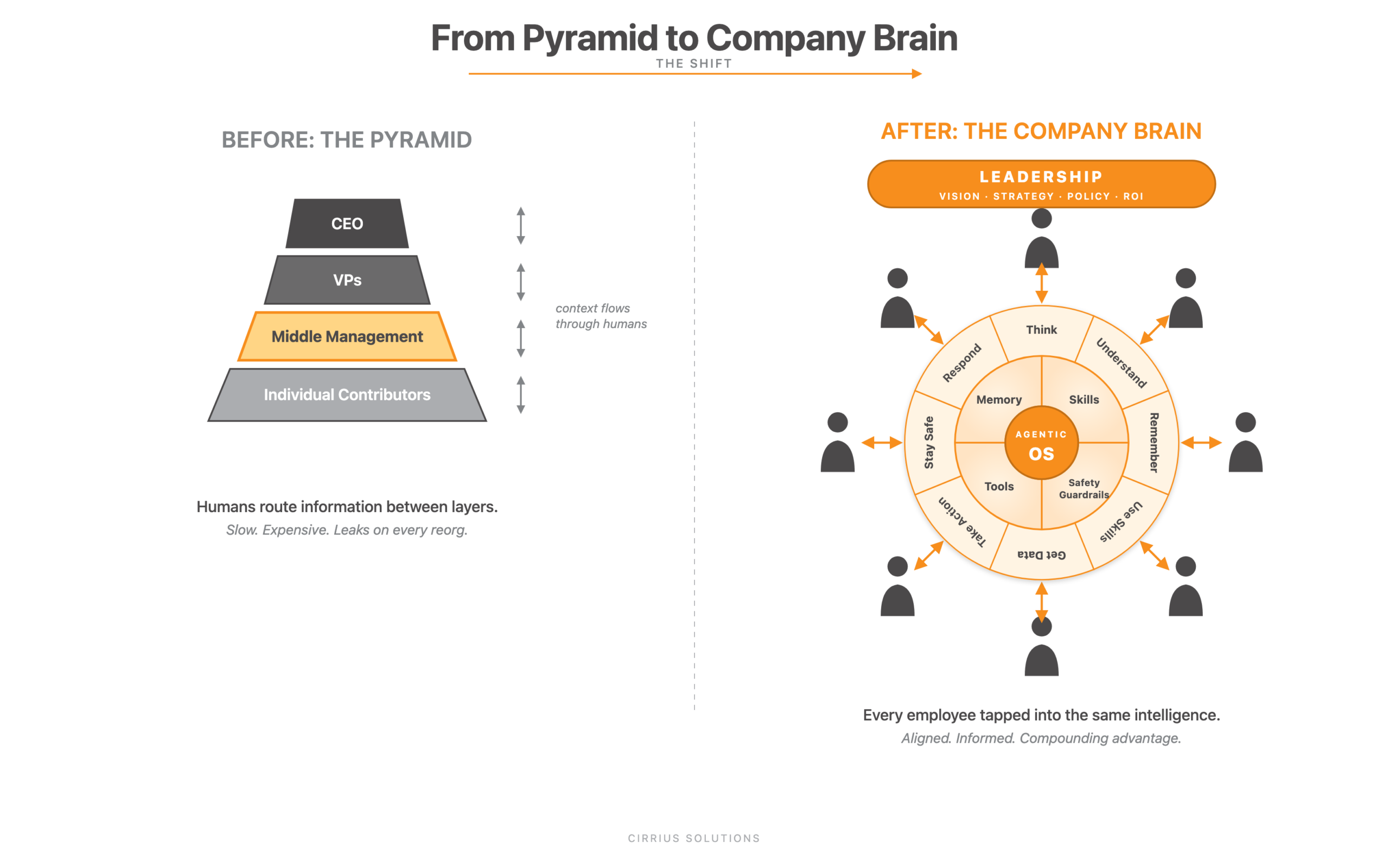
I have been listening to all the talk about AI and how companies should be organized. The layoffs at the big tech companies. The think pieces about the end of middle management. The vendor pitches claiming a copilot will transform your business by next quarter. After twenty years of building enterprise systems, I want to share how I actually see the org chart changing, what most of the commentary is missing, and most importantly, what enterprises should do about it.
Start here. The corporate hierarchy was never sacred. It is the standard way we learned to run a business when humans had to move all the information by hand. That constraint is gone.
Your Org Chart Is A Legacy Routing Protocol
For hundreds of years, every large organization has faced the same problem. How do you coordinate thousands of people when communication is slow? The answer has always looked the same. A nested hierarchy, each manager running a handful of people.
Every layer of middle management in your company exists for a specific reason. Humans can only effectively manage a handful of direct reports before cognitive overload sets in. To coordinate five thousand people, you have to add layers. Each layer has a job: route information up and down the chain, pre compute decisions, maintain alignment, translate strategy into execution.
Strip the theater away and the bulk of a middle manager’s work has always been moving context between people and keeping them aligned. Accountability and coaching are part of the job, but they are the small part. Routing information takes up a significant part of their day.
This is the part nobody says out loud. Hierarchies are slow because context has to travel through humans, and humans are expensive, inconsistent, and scarce. We put up with it because there was no alternative.
There is an alternative now.
Humans Forget. That Is The Hidden Cost Nobody Prices.
Here is a truth I do not hear anyone in the AI conversation talk about. People forget what they have learned. Not all of it. Not instantly. But at a rate that compounds across an organization.
Your best account manager solved a specific churn scenario in 2022. By 2026 she has moved roles. Two of her reports have left. The playbook she wrote is in a Google Doc nobody has opened in eighteen months. When the same scenario arrives next quarter, your current team may or may not find the playbook. More often, they will not. They will solve it again, from scratch, and pay for the learning a second time.
Multiply that pattern across a five thousand person enterprise over fifteen years and you have the largest hidden cost most companies never price. Every reorg, every departure, every promotion leaks institutional memory. The tenured people are a library that walks out the door.
Academic research pegs tacit organizational knowledge at fifty to seventy percent of what a company actually knows. Most of it is unwritten. Most of it cannot be captured in a process document. It lives in the heads of the people who have been around long enough to pattern match on their own experience.
The shift I see coming is that AI technologies act as a second brain for the organization. Information is not forgotten. When a scenario has happened before, the system recognizes it, retrieves the context, and surfaces the past experience as a present recommendation. Perfect institutional recall. That is not a marketing claim. It is what a continuously updated model of your business, fed by every artifact of how work actually gets done, does in operation.
The Company Brain Moves To The Center
Your company has a brain today. It is scattered. It lives in the heads of your Regional VPs, in the context your CFO carries, in the tribal knowledge your tenured account managers never wrote down, in the Slack threads nobody searches, in the three dashboards that disagree about the same number.
The modern org chart exists to route pieces of that scattered brain to the people who need it. A manager’s real job, stripped of the theater, is to hold context and hand it down. That is expensive. It is slow. It degrades with every reorg.
The architectural alternative I see taking shape across the best AI forward organizations is what I call the company world model. A continuously updated representation of the business, in two parts. The company side is how the organization understands itself, its operations, its priorities. The customer side is how the organization understands every person and every account it serves. Both sides are queryable. Both sides update in real time. Both sides remember everything the company has ever learned.
Here is what is genuinely interesting about this shift. The world model centralizes the corporate brain into one place. But access to that brain becomes radically distributed. Every individual contributor now has context that used to require a CEO level view to obtain. The brain is more concentrated, and simultaneously more accessible, than it has ever been in the history of organizations.
The company brain becomes an artifact. You can architect it. You can version it. You can query it. It remembers everything your organization has ever learned. Until you build it, no agent you deploy has anywhere to stand.
Middle Management Becomes The Alignment Layer
Some commentators claim middle management is simply gone. I do not believe that is what happens in a real enterprise. The information routing job is going away. The accountability, coaching, and customer-facing judgment job is not. Those responsibilities do not fit into a model. They sit with humans by design.
What actually happens is that middle management evolves into something more valuable than it has ever been. They become the alignment layer. Every output the world model produces, every action an agent takes on behalf of an employee, passes through three human-operated gates before it reaches the customer.
Customer goals. Does this recommendation match what the customer is actually trying to accomplish? Not what the model predicts they will want. What they actually want, in the specific context of their business.
Security and policy. Does this action violate data handling rules, privacy commitments, or regulatory requirements? Can we audit how this decision was made if someone asks?
ROI and business outcomes. Is this the right use of company resources? Does this agent action actually move a number that matters on the P&L?
The manager who used to spend most of the day routing context now spends most of the day at those three gates, coaching the people who execute, and working directly with the customers the work serves. Fewer managers, doing substantive judgment work, because the mechanical part of their old job is automated away.
That is a better job, not a dead job.
Leaders Drive This. It Is Not Linear.
This transformation does not delegate. If your CEO and executive team are not personally using AI as part of their daily operating rhythm, they cannot lead it. Research from Ethan Mollick at Wharton is blunt on this point. Executives who delegate AI strategy to middle management guarantee failure. The reason is simple. Leaders who do not use AI cannot evaluate the world model they are asking their organization to build. They cannot stress test it. They cannot shape the customer success signal it optimizes against. They can only approve budgets. That is how the last generation of digital transformation projects went sideways.
The other thing leaders should internalize is that this transformation is not linear. Traditional enterprise change management is a waterfall. Strategy, plan, build, deploy, adopt. That model does not work here. The new shape is iterative. A leader forms a hypothesis about what the business uniquely knows. The world model is built to test it. The model returns findings that reshape the hypothesis. The organization adapts. The cycle repeats.
If your systems integrator is selling you a waterfall, they are selling you the old transformation model with new software on top. That will produce a pilot, not a transformation.
Customer Success Is The Signal Every Decision Orbits
Efficiency and cost takeout are not the organizing principle. Customer success is. Everything else is a consequence.
The world model’s quality is measured by one question. Can you answer, with receipts, why each customer bought, stayed, renewed, or left? If the answer is strong, every downstream function (sales, marketing, product, service, success) compounds off the same foundation. If the answer is weak, you will ship agents that generate confident wrong answers and blame the technology.
This is also how the world model becomes a governance artifact. Your Sales VP and Product VP can argue forever about priorities because neither holds the definitive customer truth. The world model is the tie breaker. When the signal says “the renewal cohort for mid market healthcare is at risk because onboarding completion dropped fourteen points,” the argument resolves itself. No status meeting. No escalation. The world model is not a tool. It is how you end executive dysfunction.
What Most Of The Commentary Is Skipping
Most of what you read about AI transformation is written by founders of AI native companies or venture capitalists funding them. Their worldview is honest, but it skips the five hardest problems a real enterprise faces. At Cirrius we see these every week.
Your data is not machine readable. A remote first, digitally native startup has artifacts for every decision, every design, every discussion. That is a luxury condition. Your typical enterprise runs fifteen years of custom Salesforce objects, three ERP migrations, a warehouse that half the business does not trust, and Apex automation nobody has documented in six years. Before you build a world model, you have to earn the right to build one. Data unification is the first real program of work, not an afterthought.
Your executive team sponsors the AI budget. A founder CEO can redraw roles at a Monday all hands. You cannot. In a public, non founder led enterprise, the same middle managers being described as obsolete are the ones writing your AI business case. Frame the initiative as “eliminating your layer” and your layer ensures the pilot fails. Brief your leaders on the distinction between the information routing job (going away) and the coaching and culture job (staying) before you brief them on agents.
Regulated industries require a named human. Financial services, healthcare, pharma, government. SOX, OCC, HIPAA, GxP. Every decision rights audit trail in these industries legally requires a human in the loop. An autonomous outcome owner with full authority to pull resources across a bank’s org chart is a compliance problem before it is an AI problem. Startup commentary treats coordination as the hard part. In your environment, auditability of that coordination is the hard part.
Your alignment layer needs a retraining program. The managers who have spent ten years routing information are about to be asked to do a different job: operating the three gates (customer goals, security, ROI), coaching people, and working directly with customers. That is not an org chart change. It is a skills change for the most tenured population in your company. Budget for it, or the gates will not hold.
Agent observability is the new middle layer. When you replace a human layer with a probabilistic system, the system does not run itself. Prompt versioning. Evaluation coverage. Escalation pathways. Auditable decision logs. That is the hidden middle layer that replaces the one you collapsed. Skipping it is the single most common reason enterprise agent programs fail in month nine. The org chart flattens on paper and re inflates in operations.
Where To Start
Not “deploy a copilot.” Not “pick a first agent use case.” Those are consequences, not starting points. Start one layer deeper.
- Get leadership aligned before you get a vendor aligned. Your executive team has to be able to answer two questions in a single voice. What does your company understand that is genuinely hard to understand? What is the customer success signal every decision orbits around? If your leaders cannot answer in the same words, no architecture will save the program. This is a pre work conversation, not a kickoff deck.
- Commission your world model assessment before your agent roadmap. Map where institutional knowledge currently lives, who holds it, and what the organization loses every time a tenured person walks out. That map is your world model requirements doc. It is a scoping of corporate knowledge, not a technology exercise.
- Unify the data substrate the world model will sit on. Data Cloud, your CDP, your MDM, your warehouse, whatever your stack is. Agents do not work without this. Copilots on top of fragmented data produce confident wrong answers at scale. That outcome is worse than no agents at all.
- Build observability before autonomy. Every production agent needs prompt versioning, evaluation coverage, escalation pathways, and an auditable decision log. This is the hidden middle layer that replaces the one you collapsed. Skipping it is the number one reason enterprise agent programs fail in month nine.
- Run a Business Value Assessment on the transition, not the end state. The steady state is real. It is also three years of work. Your board is going to ask what happens in year one. A BVA frames which outcomes you can actually hit in the first two quarters, which ones are contingent on the world model maturing, and where the ROI compounds.
We Build The Transition
Cirrius Solutions does one specific thing in this category. We build the AI and Agentforce substrate that enterprise companies need before a world model becomes possible. Data unification. Capability design. Agent observability. Human in the loop design for regulated industries. The unglamorous work most commentary about this shift quietly assumes into existence.
We are not selling you seats or licenses. We are selling you the asset, built on your stack, owned by your company, that makes the shift achievable inside your constraints. And we are building it iteratively, not as a waterfall, because that is the only shape that actually works.
The question is not whether your org chart becomes an intelligence. The question is whether you get to architect the transition, or whether it architects you.
The companies that unlock AI for every employee will compound an advantage their competitors will not be able to replicate. We are doing that work ourselves, inside our own team, so we can help others do it with confidence.


