
What Happened When We Put AI Agents on the Team
There is a version of the AI story where the software does your job and you get smaller. That is not the story we are living at Cirrius.
Over the last several months we stopped treating AI as a feature inside a chat window and started treating it like staff. We gave our agents real responsibilities, real boundaries, and a place in the daily rhythm of the company. The result is not that our consultants do less. It is that they do more of the work only a person can do, and a lot less of the work that used to eat their week.
Here is the honest headline: each of our consultants is now roughly 2.5x the output, at the same quality bar. Nobody got automated out of a role. If anything, everyone got promoted into a better one.
The short version
- We stopped treating AI as a feature and started treating it like staff. Real responsibilities, real boundaries, and a place in the daily rhythm of the company.
- Each consultant is roughly 2.5x the output, at the same quality bar. Nobody got automated out of a role. Everyone got promoted into a better one.
- The agents show up when nobody is watching. They run on a standing schedule, refresh every project overnight, and flag what needs a human decision instead of guessing.
- Agents protect senior judgment rather than replace it. Prep, notes, status and first drafts are handled before your best people touch the work.
- Two loops. Agents do the work on the inner loop. People manage that work on the outer loop. That is the promotion, in one picture.
Agents as employees, not features
It is easy to say “we use AI.” Most firms do. The difference is whether the AI shows up for work when nobody is watching.
Ours does. We run a set of agents on a standing schedule, the way you would staff shifts. Every night they refresh the status of every active project and area, so that when our team logs in, the books are already current. They pull meeting notes from our calls and file them against the right account automatically. They draft, they research, they prepare, and they flag what needs a human decision instead of guessing.
Across the practice, those agents cover a spread of functions that used to require several different people or several late nights:
Delivery prep and project hygiene
Dashboards stay current on their own.
Hover for detail
Delivery prep and project hygiene
Live project and area views refresh nightly. Nobody spends Friday afternoon updating a status doc.
Meeting intelligence
Calls captured, summarized and routed within hours.
Hover for detail
Meeting intelligence
Filed against the right client record, so context does not live in one person’s head.
Content and enablement
Backlogged material now moves in a day.
Hover for detail
Content and enablement
Client-ready material, briefs, and internal write-ups that used to sit and wait.
Research and discovery
The groundwork is assembled before the consultant sits down.
Hover for detail
Research and discovery
So the thinking starts from a prepared position instead of a blank page.
None of this is a demo. It is a library of roughly fifty distinct agent skills and a set of standing automated jobs that run whether or not anyone asks. The point is not the count. The point is that the work is reliable enough to depend on, which is the difference between a clever tool and an actual teammate.

Why this matters for a Salesforce practice
Complex Salesforce work has always had a bottleneck, and it is not licenses. It is senior human judgment. The architect who can see the whole board. The consultant who knows which question to ask the client. That capacity is finite, and it is the reason good implementations take as long as they do.
Agents do not replace that judgment. They protect it. When the prep, the note-taking, the status updates, and the first drafts are handled before your best people touch the work, those people spend their hours on the part that is genuinely hard. That is how you get to 2.5x the output per person. Not by working faster under pressure, but by pointing scarce expertise at the problems that deserve it.
For a client, the felt experience is simple. Discovery is better prepared. Meetings start with the context already in the room. Deliverables show up sooner and land closer on the first pass. You get more, faster, at the same standard. We are not doing cheaper work. We are doing more of the valuable work in the same window.
Agents that manage agents
The pattern that surprised us most is how quickly this compounds. We have deployed two agents to every employee: an operations agent and a development agent. Those agents spin up their own sub-agents, specialists for whatever the job in front of them needs. Research, design, development, testing, deployment.
So one person is not working with one assistant. They are directing a whole team of specialists.
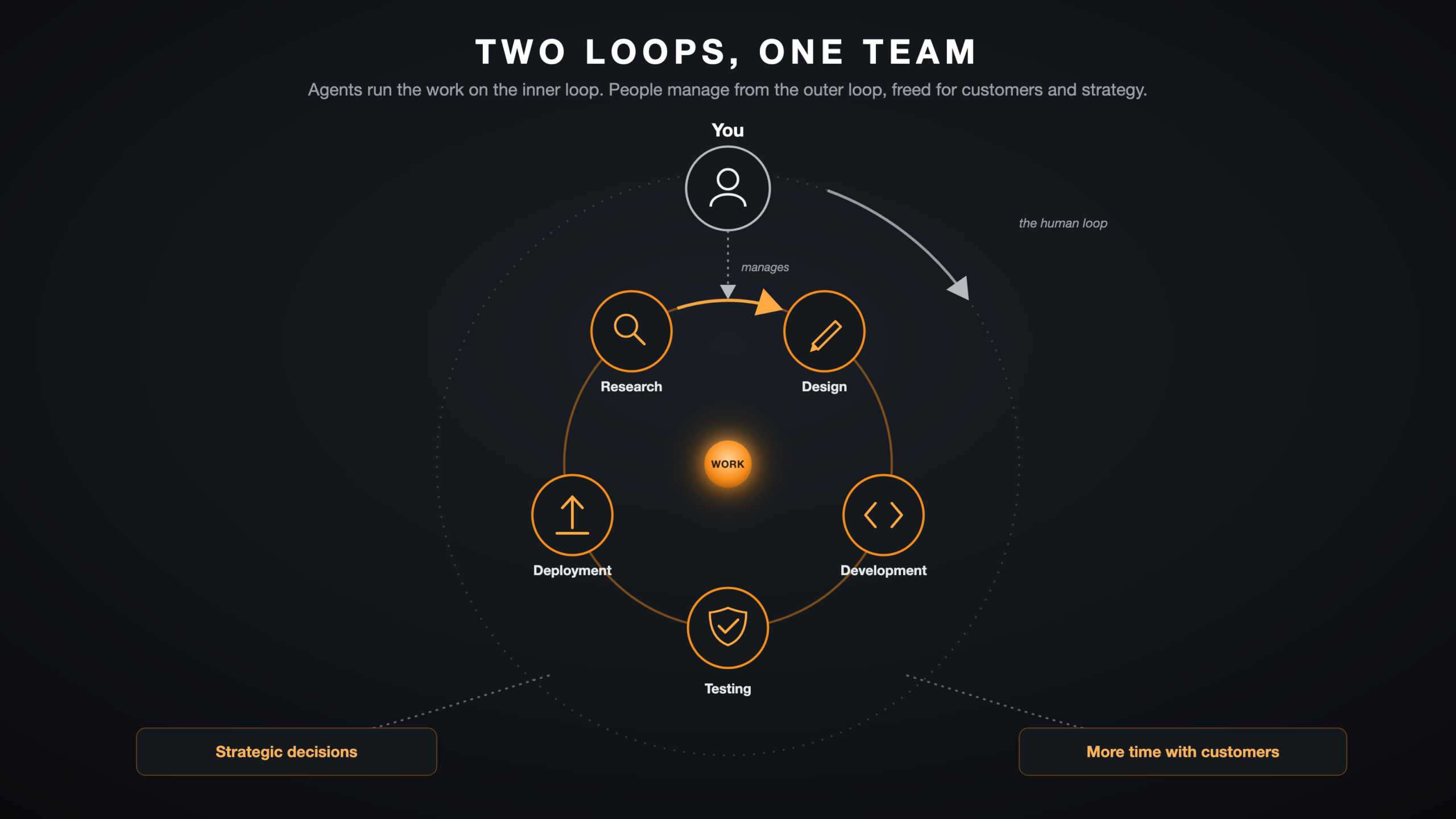
We think of it as two loops. On the inner loop, the agents do the work together, handing it around the ring. On the outer loop, our people manage that work instead of doing it. That is the promotion, in one picture: our consultants moved from doing the routine work to directing it, which frees them for the two things only people can do, time with customers and the strategic calls.
The intelligent organization
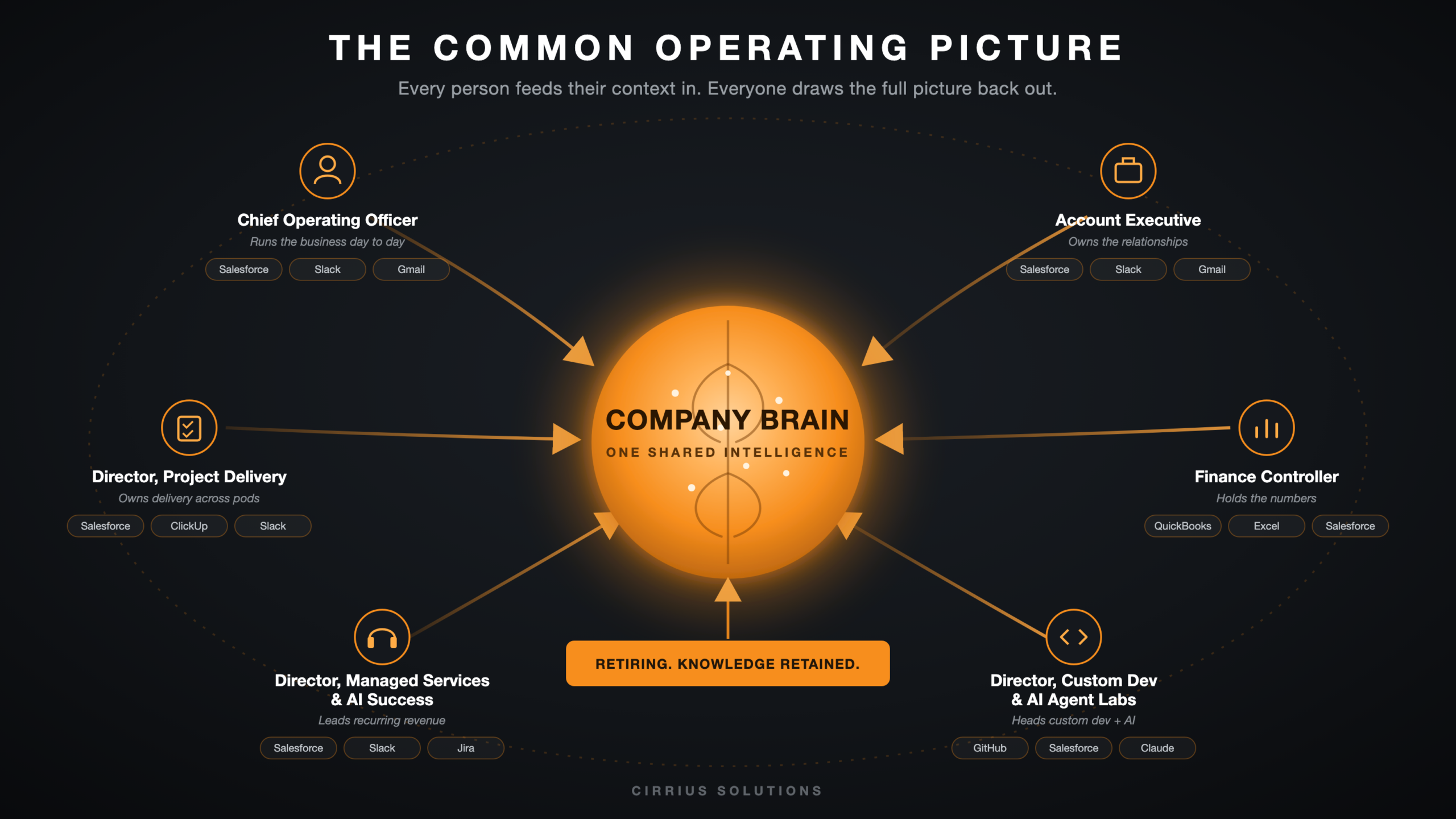
Underneath all of this is one idea: AI connects every employee to a shared organizational brain, giving people faster access to knowledge, better support, and greater capacity to get work done.
The organization no longer depends on information living in individual inboxes, documents, or people’s heads. Knowledge is captured, shared, and continuously improved, so when employees change roles or leave, the intelligence stays behind.
The result is a smarter, faster, more resilient organization, where every employee is more capable and the company gets better with every interaction. Smarter people, connected knowledge, stronger execution.
Promoted, not automated
The part I did not expect was how the team would feel about it.
When you take the tedious portion off someone’s plate, they do not feel threatened. They feel unblocked. The consultant who used to lose a day a week to documentation is now in front of clients. The person who dreaded the status grind is doing architecture. Give people their judgment back and hand the busywork to something that never gets tired of it, and morale goes up, not down.
That is the quiet lesson under the productivity number. The companies that win the next few years will not be the ones that bought the most AI. They will be the ones that figured out how to manage it. How to give an agent a job, a boundary, and a place in the workflow, and then trust it to show up. That is an operating discipline, not a purchase.
Where to start
If you want your own organization to run this way, you do not begin with a moonshot. You begin with the boring, repeatable work that quietly consumes your best people’s time:
Pick one recurring chore that happens on a schedule and does not require judgment. Status updates, meeting notes, or first-draft research are ideal.
Give the agent a boundary. Define what it owns, what it must escalate, and what it is never allowed to touch. Trust follows clear limits.
Put it on a shift. Let it run on a schedule, unattended, and check its work the way you would review a new hire’s.
Promote your people into the gap. Redirect the reclaimed hours to the judgment-heavy work only they can do. That is where the return actually shows up.
The bottom line
We staffed AI like a team instead of buying it like a tool. Output per person is up to roughly 2.5x, quality held, and our people moved up the value chain instead of out the door. For our clients that means faster, better-prepared, more consistent delivery. For our team it means fewer late nights and more of the work that made them want to do this in the first place.
We are a Salesforce partner that decided to run our own shop on agents before we ever recommended them to anyone else. If you want to see what that looks like in practice, let’s talk. It is a conversation I would genuinely enjoy.


