

Why AI Agents Forget, and Where Their Memory Should Live
Your service agent handled a customer beautifully on Tuesday. On Thursday the same customer comes back, and the agent greets them like a stranger. It asks for the order number again. It suggests the fix that already failed.
Nothing broke. The agent did exactly what it was built to do. It simply has no memory past the end of the conversation.
That gap shows up right after most first agents go live, and it is exactly what an Agentforce Data Cloud architecture is built to close. Salesforce now calls the product Data 360 (formerly Data Cloud), and the clearest way to think about it is this: the context window is your agent’s short-term memory. Data 360 is its long-term memory.
The short version
- Two kinds of memory. The context window resets every session. Data 360 is where facts, history, and outcomes persist.
- One memory, many agents. Agentforce agents and custom Claude or OpenAI agents can read from and write to the same Data 360 memory, so knowledge compounds instead of splintering.
- Write back is the multiplier. An agent that only reads is a search box. An agent that writes outcomes back makes the next agent smarter.
- Governance comes with it. Memory sits inside your Salesforce permission model and audit trail, not in a side database nobody owns.
- Start with one memory that costs you money. Asset history, case history, or account context. Not everything at once.
Salesforce Just Started Calling It Memory
This is not our metaphor alone. At Dreamforce 2026, Salesforce described Data 360 as the place that brings together harmonized and federated data, metadata, and memory (Salesforce). Its CTO framed the new Agent Context Engine, planned for general availability in December 2026, as the fix for agent silos, where separate agents keep separate memories and nothing carries over (SF Ben).
Salesforce tested the idea on itself first. Its Dreamforce event agent used unified attendee profiles as a system of context and carried past conversations forward, so attendees never had to repeat themselves. Session show rates rose 30% (Salesforce customer story).
The data says why this matters. In Salesforce’s 2025 State of Data and Analytics survey of more than 7,600 leaders (source), the numbers were blunt:
Agents do not fail because the model is weak. They fail because they are reasoning without the history your business already has. Gartner puts it plainly: organizations will abandon 60% of AI projects that are not supported by AI-ready data (Gartner).
The Four Kinds of Memory an AI Agent Needs
Researchers who study agents split memory into four types (CoALA, Princeton). It is a useful map, because it shows exactly which parts Data 360 owns and which parts live in the agent itself.
Working memory
What the agent is thinking about right now.
Hover for detail
Working memory
The context window. Agentforce’s Atlas Reasoning Engine assembles it fresh for every turn. Fast, powerful, and gone when the session ends.
Semantic memory
What is true about your business.
Hover for detail
Semantic memory
Unified customer and asset profiles, harmonized data model objects, and calculated insights in Data 360. One record of truth every agent can trust.
Episodic memory
What happened before.
Hover for detail
Episodic memory
Every conversation, case, visit, and outcome, captured in Data 360 engagement data and Agentforce session tracing. This is the memory most agents are missing.
Procedural memory
How to do the job.
Hover for detail
Procedural memory
Topics, instructions, and actions in Agentforce, or skills in a custom agent. It lives in the agent definition, and it gets better when episodic memory shows what worked.
Here is the point. Data 360 gives every agent semantic and episodic memory, the two layers that turn a clever chatbot into a coworker who knows your customers. Working memory and procedural memory belong to the agent. The architecture works when the two halves are designed together.
The Agentforce Data Cloud Architecture, Layer by Layer
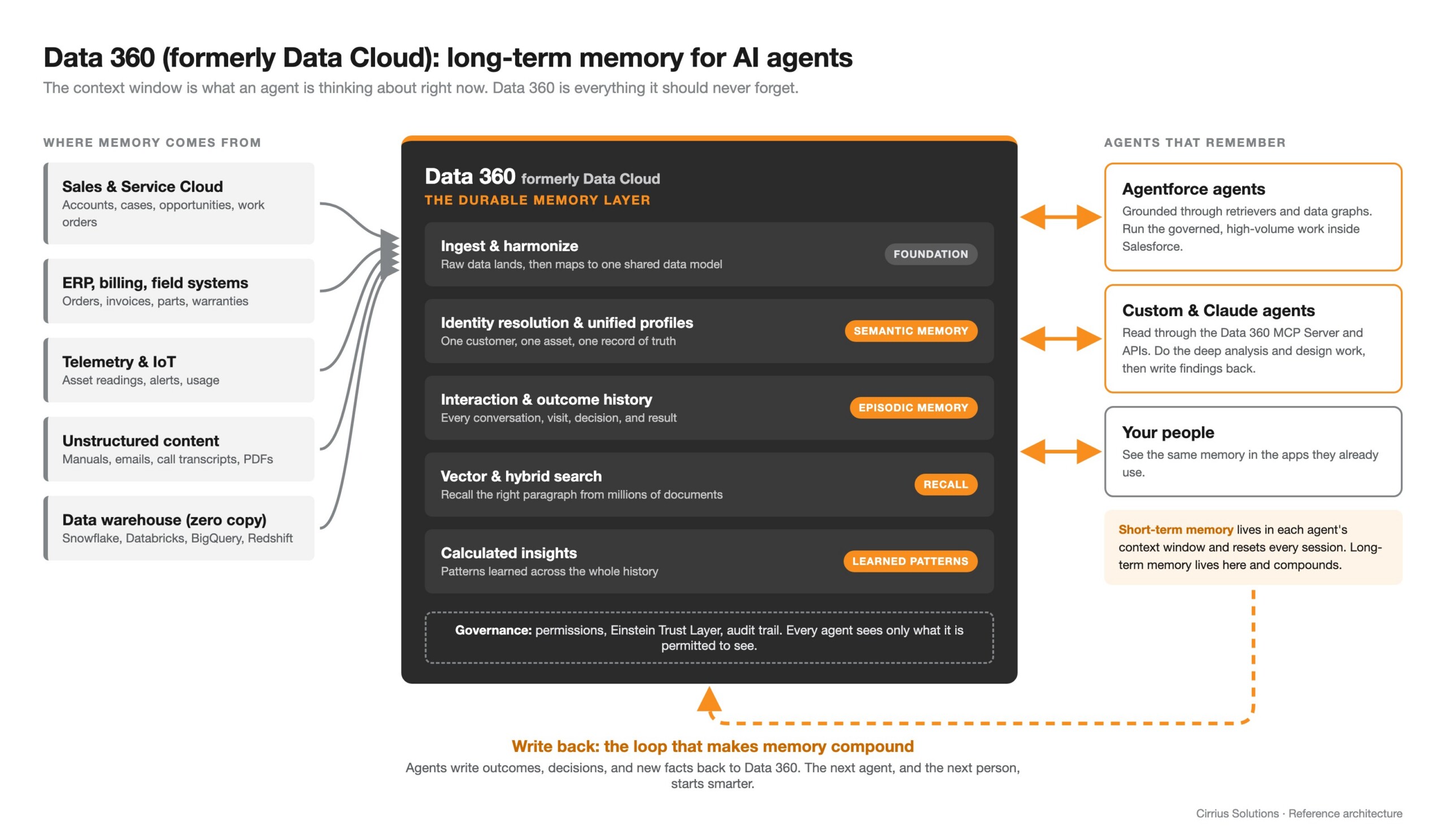
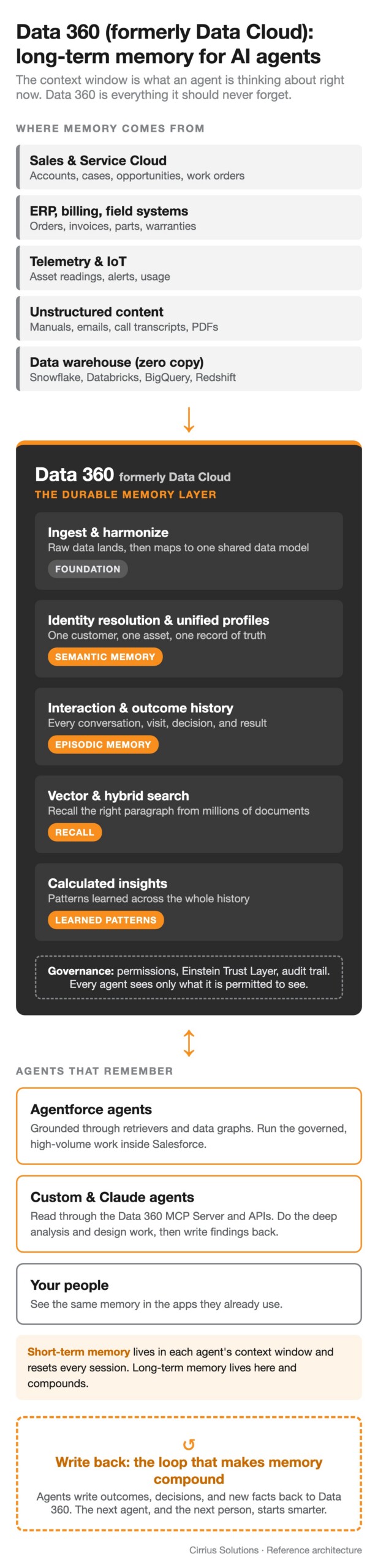
Follow memory from your systems into Data 360, out to every agent, then back again. That return loop is the whole idea.
- Ingest without copying everything. Connectors and the Ingestion API bring in CRM, ERP, telemetry, and documents. Zero copy federation reads Snowflake, Databricks, BigQuery, and Redshift tables where they already live.
- Harmonize into one model. Raw data lands in data lake objects, then maps to data model objects. Identity resolution turns five records for the same customer or machine into one unified profile.
- Make documents recallable. Manuals, emails, and transcripts are chunked into a hybrid search index, vector plus keyword, so an agent recalls the right paragraph instead of the right file.
- Serve every agent from the same memory. Agentforce reads through retrievers and real-time data graphs. Custom Claude and OpenAI agents read through the Data 360 MCP Server, the Query API, and the Data Graph API, authenticated as an External Client App.
- Write back. Agents stream outcomes, decisions, and new facts back through the Ingestion API. Data actions can fire downstream work the moment memory changes.
- Govern all of it. Salesforce permissions decide what each agent can see, the Einstein Trust Layer keeps prompts out of third-party model retention, and every read and write leaves an audit trail.
“Memory can preserve approved facts from earlier interactions.”
Salesforce, Why Your AI Needs Trusted Context, October 2026
Notice the word approved. Long-term memory is not a transcript dump. The value comes from distilling interactions into facts that a person or a rule has agreed are true, then letting every agent use them.
Use Case: The Technician Who Has Seen This Machine Before

Picture an industrial equipment manufacturer with thousands of installed machines and a field service team. Today, every service visit starts from zero. The technician sees the work order, maybe the last visit note, and a PDF manual. The history of that specific machine is spread across Service Cloud, the ERP, a telemetry platform, and three people’s inboxes.
Now give the agents a memory.
- A telemetry alert arrives. Vibration on a machine is trending up.
- An Agentforce service agent recalls the machine. Install date, warranty status, every part replaced, the last three visits, and the fix that did not hold. It pulls the right section of the manual through hybrid search, opens the work order, and stages the likely parts.
- The technician arrives already briefed. Same memory, in the mobile app they already use.
- The outcome is written back. What failed, what fixed it, which part, how long it took.
- A custom Claude agent studies the fleet every week. It finds that one bearing fails early in high-humidity sites, writes that known failure signature back to Data 360 as an approved fact, and the Agentforce agent uses it on the very next alert.
That last step is the pattern we use everywhere: the custom agent designs it, Agentforce runs it. The deep analysis happens in a custom agent. The governed, high-volume execution happens in Agentforce. Data 360 is the shared memory that connects them. (We unpack that split in Agentforce vs Custom AI Agent.)
The value, in numbers. Illustrative only, and assumptions are required. Take a team running 20,000 service visits a year. Lifting the first-time fix rate from 75% to 80% avoids 1,000 return visits. At an assumed fully loaded $600 per return visit, that is $600,000 a year, before you count parts staged correctly, warranty claims caught, and customers who stop calling your competitor. Run it with your own visit volume and cost per truck roll.
Two More Places AI Agent Memory Pays Off Fast
Service that never asks twice
Customers will forgive a lot. Repeating themselves is not one of those things. When case history, prior conversations, and the customer’s unified profile live in Data 360, a new conversation on any channel starts where the last one ended. The Dreamforce result above, a 30% higher show rate, came from exactly this. OpenTable grounds its Agentforce agent in more than 1,500 knowledge articles indexed in Data 360 and resolved 73% of cases within its first three weeks (Salesforce customer story).
Accounts that never have to re-explain themselves
In B2B sales, context walks out the door with every rep change. A custom research agent can compile the buying committee, open risks, and what the account said in the last five meetings, then write those facts back to Data 360. Agentforce sales agents and your reps both work from the same account memory, and every new meeting adds to it instead of starting over.
Where Agent Memory Projects Go Wrong
- Hoarding instead of remembering. Loading every log line into Data 360 burns credits and buries the facts that matter. Decide what is worth remembering first.
- Read only agents. Without write back, memory never grows. The second agent is no smarter than the first.
- Agent silos. Every team spins up its own vector store outside Salesforce. Now you have five memories, five permission models, and five versions of the truth.
- Ungoverned writes. An agent that can write any “fact” will eventually write a wrong one. Approve what becomes memory, and keep the audit trail.
- Assuming the Trust Layer covers everything. It keeps prompts out of third-party model retention, but Salesforce notes that data masking is turned off for agents (Salesforce Help). Your permission model is the real control, which is why we start every org with a permission audit (our Claudeforce readiness approach).
Where to Start With Agentforce and Data Cloud
Pick one memory that costs you money when it is missing. Asset history, case history, or account context. Tie it to one number, like first-time fix rate or repeat contacts.
Unify that one entity first. Run identity resolution on it, use zero copy where the data already lives in your warehouse, and fix the data problems that block it (here are the five we see most).
Design the write back before the agent. Decide which facts an agent may write, who or what approves them, and how long they live. This is the step most teams skip.
Connect both kinds of agents to the same memory. Agentforce for governed volume, a custom Claude or OpenAI agent through the Data 360 MCP Server for deep analysis. Measure the one number from step 1.
Agentforce Data Cloud FAQ
Is Data Cloud required for Agentforce?
Agentforce runs on Data 360 (formerly Data Cloud), and the features that give agents memory, such as retrievers, hybrid search over documents, and session tracing, all live there. The real question is not whether you have it, but how much of your business you bring into it and whether your agents write anything back.
How do Claude or OpenAI agents access Data 360?
Through the Salesforce hosted Data 360 MCP Server, the Query API, or the Data Graph API, using an External Client App for OAuth. They can write back through the Ingestion API. The same Salesforce permissions apply, so an external agent sees only what it is allowed to see.
What is the difference between short-term and long-term agent memory?
Short-term memory is the context window, everything the agent can see during one conversation. Long-term memory persists across conversations, agents, and channels. In a Salesforce architecture, Data 360 holds the long-term memory, and each agent assembles its short-term memory from it at the moment it needs it. We cover the broader idea in The Company World Model Comes Before the Agent.
We Build Agents That Remember
Cirrius is a Salesforce partner, the 2027 Salesforce Partner of the Year for Customer Value, and an Anthropic and OpenAI Services Partner. We have spent the last 12 months connecting Claude to Salesforce, and we run more than 50 AI agents in production on our own business, every one of them on a shared, durable memory instead of a blank slate.
We design the Data 360 memory layer, build the Agentforce and custom agents on top of it, and hand you the asset. Borrow the expertise, build the asset.


