
What Happens When Your Agent Has Its Own Team
A few weeks ago I wrote about putting AI agents on our team at Cirrius. The short version was that we stopped treating AI like a tool and started treating it like staff, and our consultants ended up producing about 2.5 times the output at the same quality bar. Nobody got automated out of a job. People got promoted into better ones.
That post described one person and their agents.
What has happened since is more interesting, and it is the part I did not see coming. The agents started working with each other.
The short version
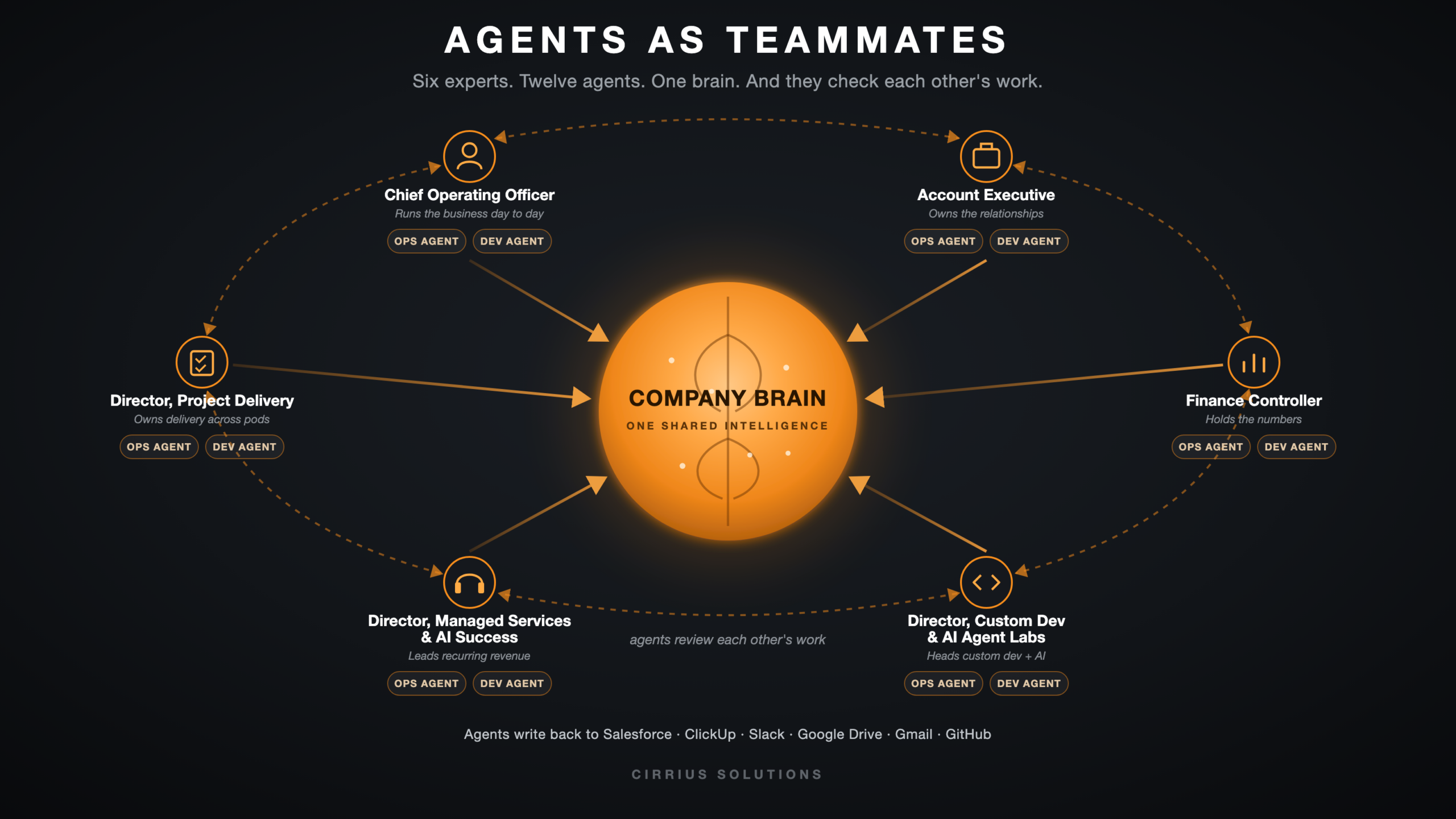
- The agents started working with each other. Six leaders, twelve agents, one shared brain. The org chart now carries about three times as many workers as it has people.
- Teammate, not task taker. A task taker waits for an assignment and stops. A teammate has standing responsibilities, works overnight, and disagrees with other teammates.
- One person’s agent corrected another person’s agent. No human refereed it. The review loop became free, so it always runs, and quality went up rather than just speed.
- Reading is a demo. Writing back is the job. The agents update Salesforce, ClickUp and Drive, so context lands in the systems of record instead of somebody’s notes.
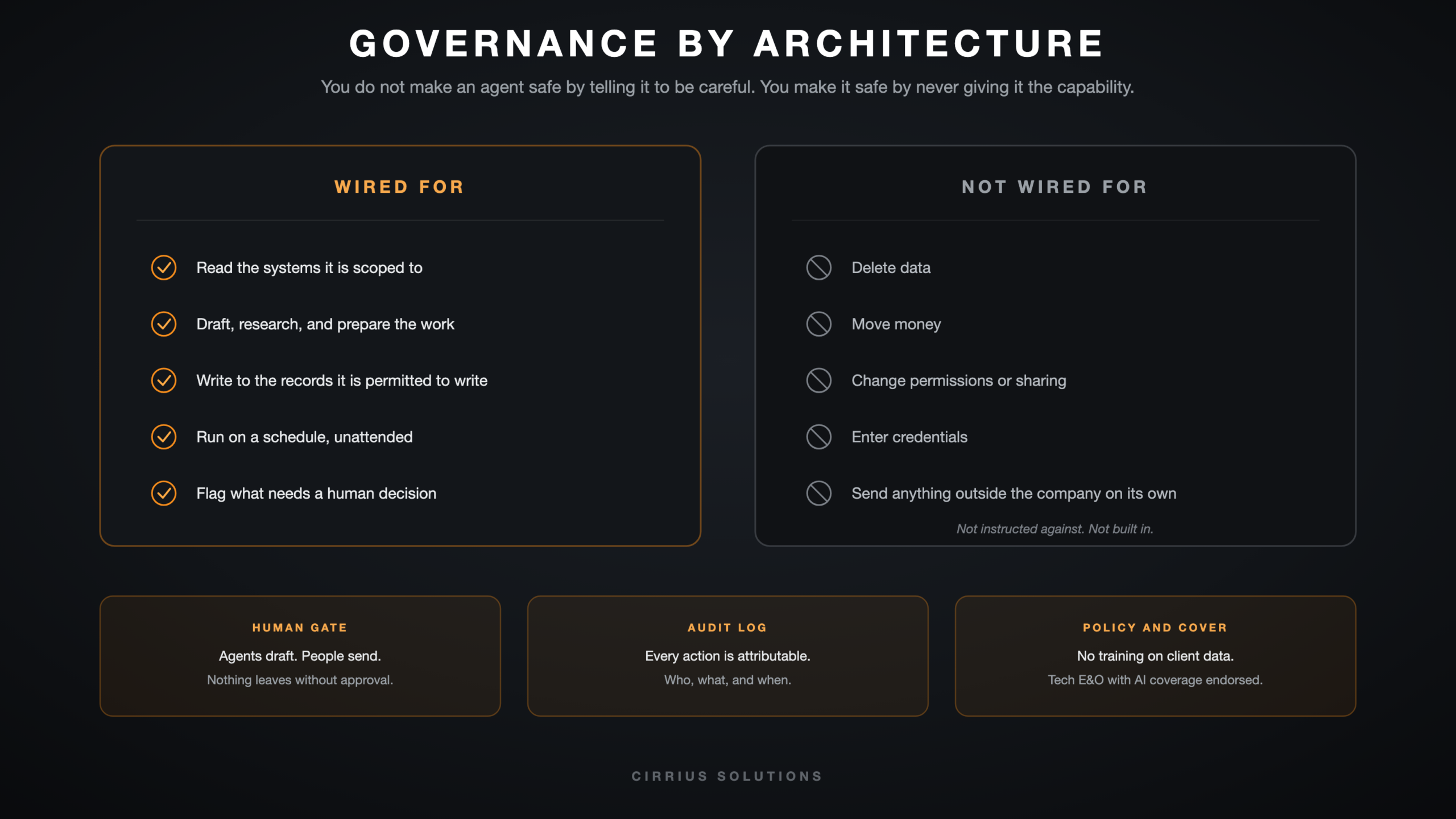
- Safety is architectural, not instructional. Agents cannot delete data, move money, change permissions or enter credentials. Not told not to. Not wired for it.
Everyone has an AI agent team now
Here is the shape of it. Six leaders across our business. Each one has at least two agents, an operations agent and a development agent. Six experts, twelve agents, one shared brain in the middle that every one of them reads from and writes to.
The floor of two is deliberate. More spin up as the work demands it. A heavy discovery week might stand up four more and then release them. But the baseline is that nobody here works alone anymore, and our org chart now carries about three times as many workers as it has people.
The word I keep coming back to is teammate, not task taker. A task taker waits for an assignment, does the thing, and stops. That is what most people mean when they say they use AI. A teammate has standing responsibilities, works while you are asleep, and, this is the part that matters, disagrees with other teammates.
My agent reviewed my COO’s agent’s work
Here is a real one.
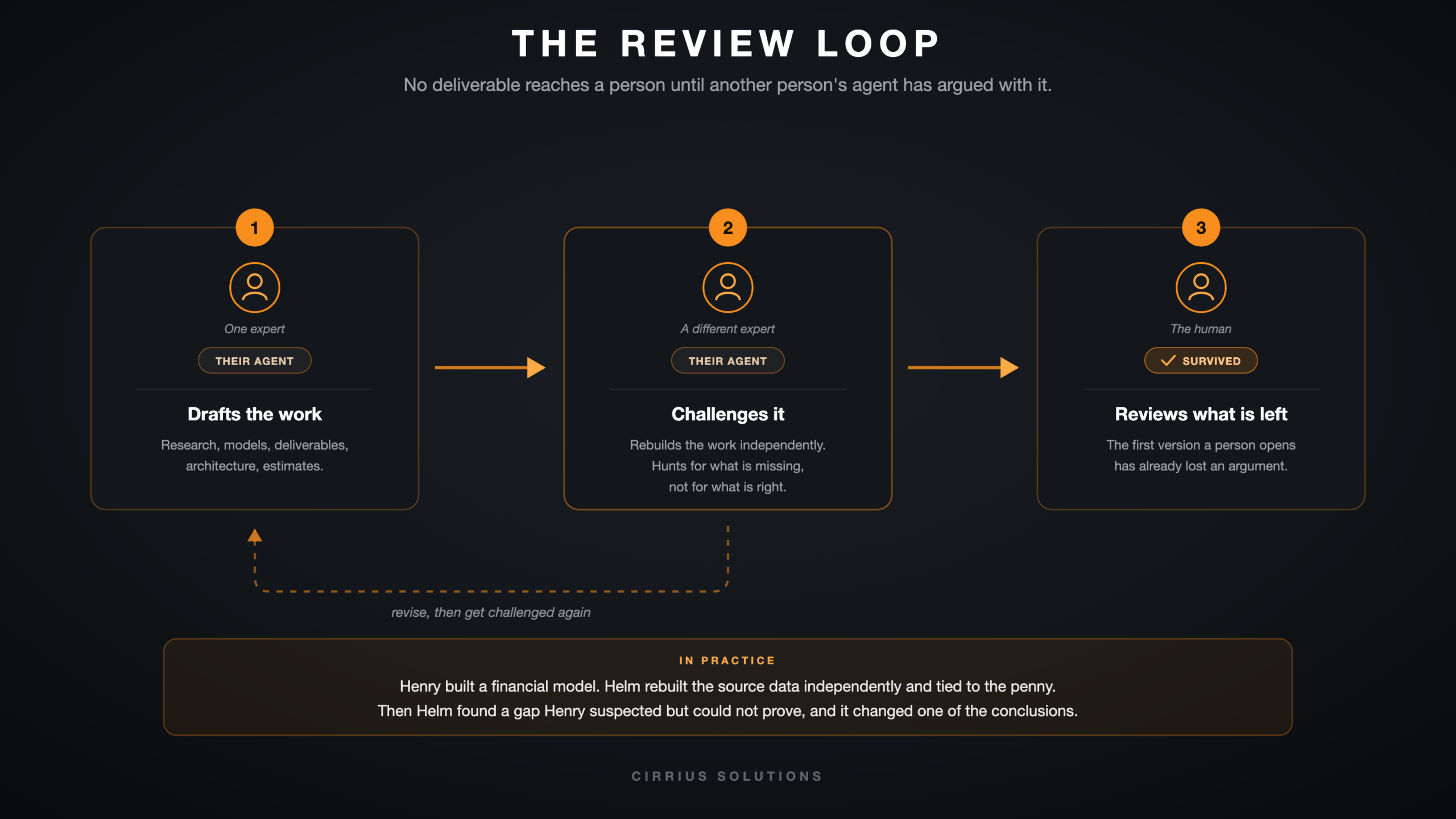
My agent, Henry, built a financial model. Then my COO’s agent, Helm, re-ran the underlying data pull from scratch, without seeing Henry’s work. The two tied to the penny.
Then Helm went further. It found a gap in the source data that Henry had suspected but could not prove, and that gap changed one of the conclusions.
Read that again. One person’s agent corrected another person’s agent. No human refereed it. I got a better answer than either would have produced alone, and I got it the same day instead of the following week.
That is not a task taker. That is a second set of eyes that happens to belong to a colleague.
We work this way across the board now. Someone’s agent drafts a solution approach, and a teammate’s agent, with a different owner and a different vantage point, challenges it before a human ever opens the file. Strategy documents, client deliverables, architecture decisions, estimates. The first version that reaches a person has already survived an argument.
Which is why quality goes up, not just speed
This is a correction I would make to my own last post.
Last time I said output went up and quality held. That was true then. It is now understated. Quality is going up, and I can point at the mechanism instead of just asserting it.
Nobody ships a first draft. Every meaningful deliverable gets challenged by an agent that did not build it and has no stake in defending it. Anyone who has tried to run a real peer review process at a services firm knows how hard that is to sustain with people. It is the first thing to get skipped when a deadline is close, and the deadline is always close. Agents do not skip it, do not get tired of it, and do not soften the feedback because they have to sit in a meeting with you tomorrow.
The compounding effect is not that we have more agents. It is that the review loop became free, so it always runs.
They write, not just read
I want to be precise about one thing, because it is where a lot of “we use AI” claims quietly fall apart.
Our agents are not summarizing. They are operating. They update Salesforce, ClickUp, Google Drive, and our internal project pictures. When a delivery lead’s agent learns something on a call, that context lands in the record, and the account executive’s agent sees it without anyone forwarding anything. We are adding a field on the Salesforce Account built specifically to carry the shared operating picture, so the current state of a client relationship lives in the system everyone already works in rather than in somebody’s notes.
That is the whole game. Reading is a demo. Writing back into the systems of record is what turns an agent into a coworker.
The question everyone asks second
The first question I get is what the agents do. The second question, always, is whether this is safe. That is fair. The headlines are full of agents going places they should not go.
Our position is architectural rather than reassuring.
“You do not make an agent safe by telling it to be careful. You make it safe by never giving it the capability.”
Chad Anderson, CEO, Cirrius Solutions
Scoped at the system level
Not by instruction inside a prompt.
Hover for detail
Scoped at the system level
Where read only is the right answer, the connection itself is read only, regardless of how senior the person authorizing it happens to be. Our agents cannot delete data, move money, change permissions, or enter credentials.
A human gate on anything outbound
The agent drafts the email. A person sends it.
Hover for detail
A human gate on anything outbound
Nothing leaves the company without a person in between.
Logged and attributable
Who, what, and when. Not a guess.
Hover for detail
Logged and attributable
Every action is recorded, so when something looks strange we can answer the question instead of reconstructing it.
The boring part that survives review
Policy, contracts, and insurance.
Hover for detail
The boring part that survives review
Written policy covering responsible AI use, data privacy, logging and monitoring, and vendor risk. Model providers contractually barred from training on client data. Technology errors and omissions insurance with AI coverage specifically endorsed.
None of that is theoretical. It is a documented control set that has already stood up to enterprise security review.
The pyramid is upside down
Now the part I think actually matters if you buy consulting.
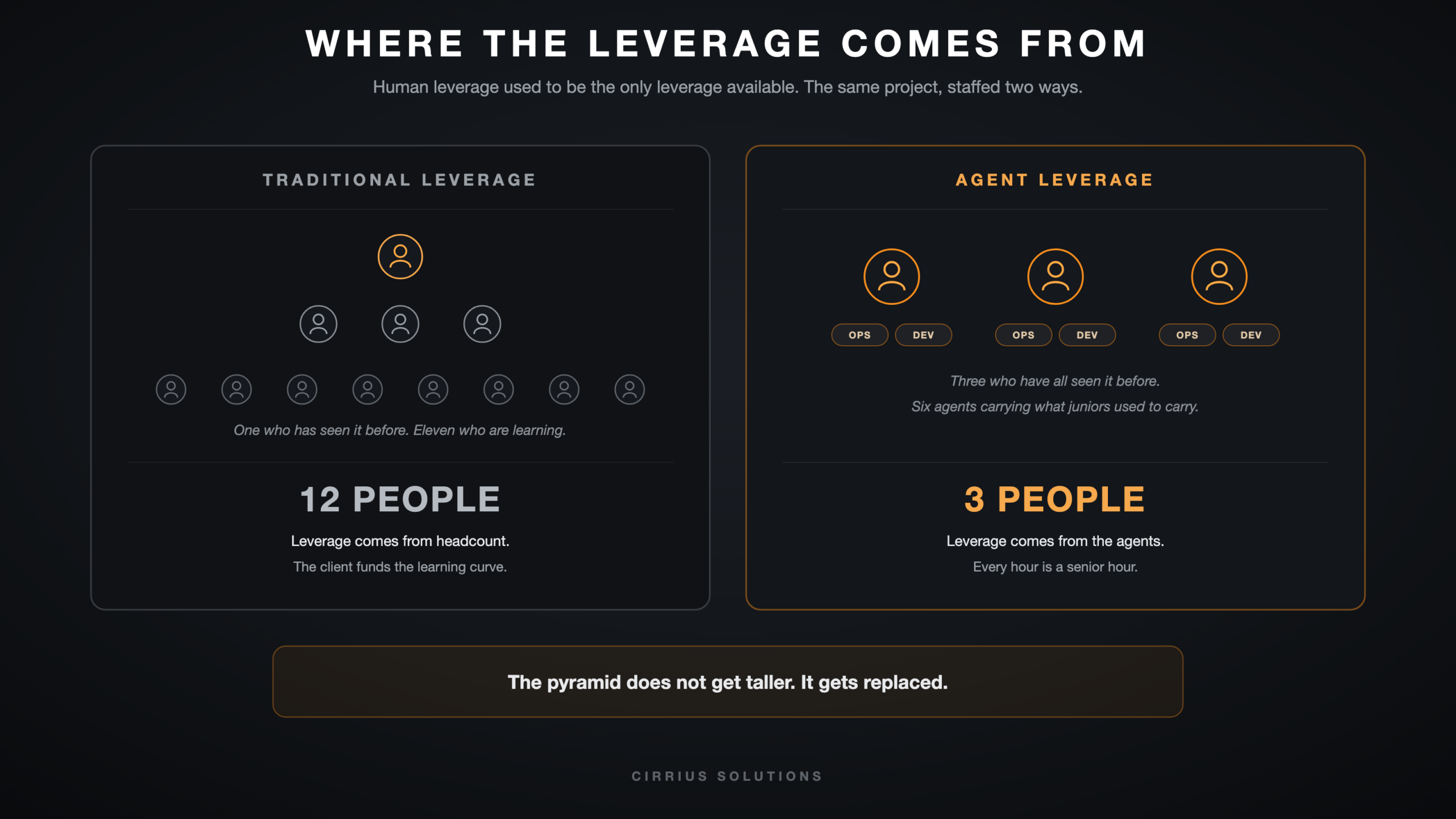
Traditional professional services runs on human leverage. One experienced person sits on top of a stack of juniors, and the economics work because the juniors bill. It is a fine model. It is also why a project that genuinely needs three good brains shows up with twelve people, and why clients quietly fund somebody’s learning curve.
That model exists because human leverage used to be the only leverage available.
It is not anymore. When every senior person carries a team of agents, the leverage comes from the agents instead of from the junior tier. So we field fewer, more senior people and cover the same ground. The pyramid does not get taller. It gets replaced.
I am not going to name firms, and I do not think the big ones are bad at what they do. I think the model is about to look very expensive.
What a client actually feels
None of this shows up in a client meeting as an architecture diagram. It shows up three ways.
You go live sooner
The same team covers more ground each week.
Hover for detail
You go live sooner
That compresses the calendar, and in nearly every conversation I have, speed to go live is the thing the client actually wants.
The first pass is closer
Deliverables were challenged before you saw them.
Hover for detail
The first pass is closer
So review cycles get shorter and the back and forth gets shorter with them.
Context stops falling on the floor
What one person learns, the team knows.
Hover for detail
Context stops falling on the floor
Because it went into the systems instead of into a notebook.
The short version
Last year the question was whether AI could do the work. That is settled. The question now is whether you can manage it, and managing is a different discipline than buying.
We did not buy more AI. We changed the org chart. Six experts, twelve agents, one shared brain, agents that review each other’s work, and hard boundaries around what any of them can touch. The result is faster delivery at a higher quality bar.
If you want to see what that looks like from the inside, that is a conversation I would genuinely enjoy. Get in touch with Cirrius Solutions.


