

Your AI agents think slowly about everything. They should not.
In Thinking, Fast and Slow, Daniel Kahneman split the mind into two systems. System 1 is fast, automatic, and cheap. It is the gut call that tells you a face is angry or a car is drifting into your lane. System 2 is slow, deliberate, and expensive. It is what you use to do your taxes or weigh a job offer.
You make thousands of System 1 calls a day and save System 2 for the hard stuff. That is not laziness. It is the design that lets you function.
Now look at how most AI agent pipelines run. Every single decision, even “is this email a complaint or a question,” goes to a large language model that reads, reasons, and writes a paragraph about it. That is System 2 doing System 1’s job. It works, but it is slow and it gets expensive fast. The new Jev AI model from TypeSafe is the first model built specifically to be System 1, and it changes how you should design agents.
The short version
- Two kinds of thinking. System 1 is the fast gut call. System 2 is slow, deliberate reasoning. Your AI agents need both.
- The Jev AI model is System 1. It answers typed questions with a number and a confidence score in milliseconds, and never writes prose.
- LLMs stay System 2. Claude and Agentforce keep doing the reading, reasoning, and writing that a decision model cannot.
- Confidence is the hand off. Clear calls get automated. Uncertain ones go up to System 2 or a person.
- Salesforce stays the spine. Every fast decision and every deep one lands in your system of record.
What the Jev AI model actually is
TypeSafe released Jev in September 2026 and calls it a System One model. It is not a chatbot and it is not another LLM. You hand it text or JSON, ask it a typed question, and it hands back a structured answer. Never a sentence.
- Choice. Pick one option from a list you define, with a probability for each.
- Score. Rate something against levels you describe.
- Yes or no. Return a probability that the answer is yes.
Every answer comes with a confidence value. Because there is no prose to generate, the output is nearly free and the response is close to instant.
Those numbers are TypeSafe’s own, and nobody has published an independent benchmark yet. Our team’s hands on testing points the same direction: decisions that took an LLM ten to thirty seconds came back from Jev essentially instantly, for a few cents across hours of testing.
System 1 and System 2: how the two brains split the work
The point is not to pick one. The point is to put each brain where it belongs. Here is the pattern we use when designing a System 1 and System 2 agent pipeline.
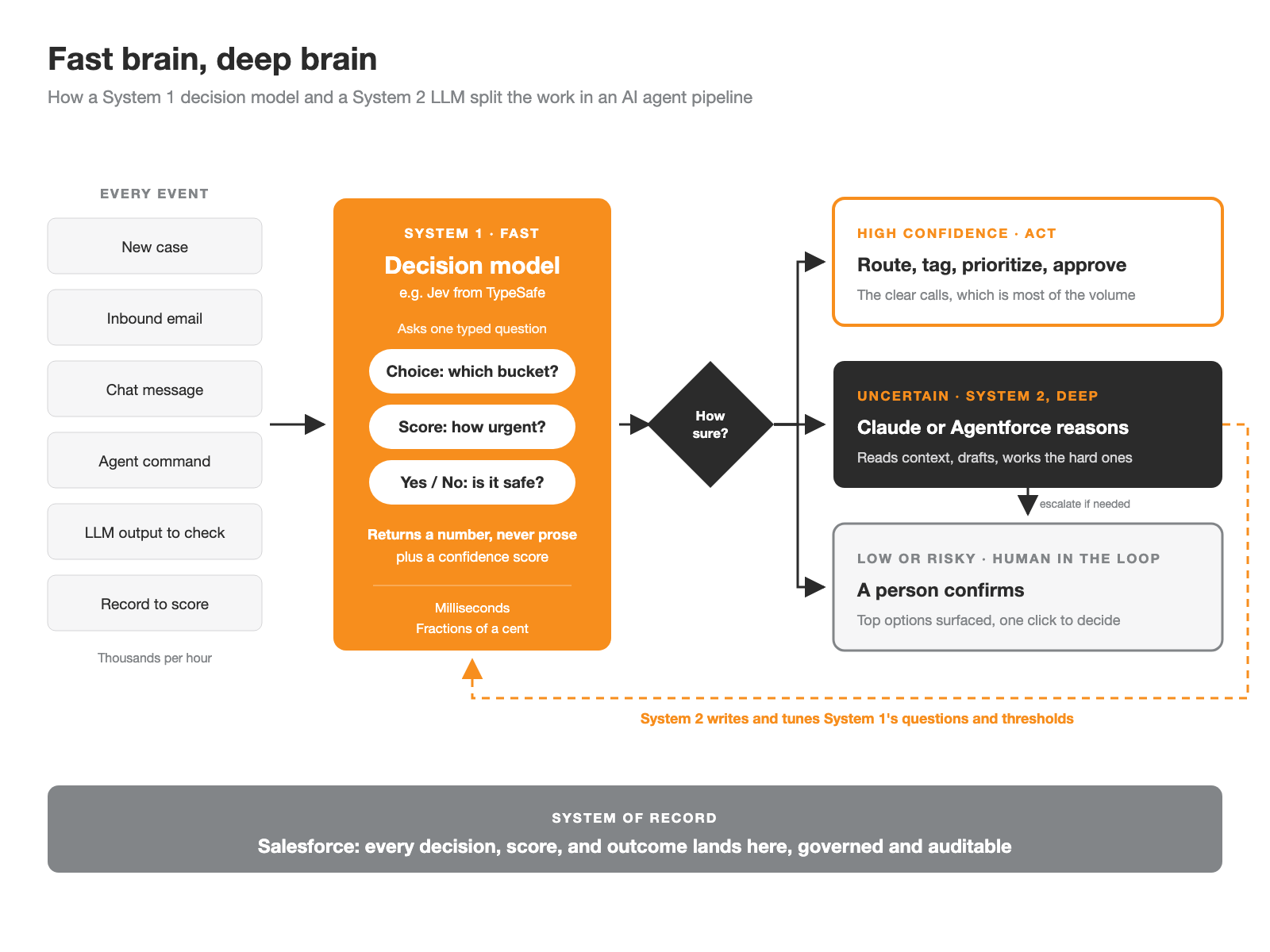
- Every event hits System 1 first. New cases, inbound email, chat messages, agent commands, and LLM output all get a fast typed question.
- A confidence check routes the result. Clear calls get automated. Uncertain ones move up.
- System 2 takes the hard ones. Claude or Agentforce reads the context, reasons, drafts, and decides, escalating to a person when it should.
- Humans confirm, they do not grind. People see the top options and decide in one click.
- Salesforce is the system of record. Every decision, score, and outcome lands there, governed and auditable.
Our lead developer, Gavin Franklin, describes System 1 as a logic gate inside an agentic operating system. In a pipeline that runs eight to ten steps, three or four of those steps are usually snap decisions. Moving those to System 1 makes the whole harness faster and cheaper without touching the reasoning steps that actually need an LLM.
“It’s not in place of large language models. It’s designed to be used with large language models.”
Tim Harting, Cirrius Solutions, on Cirrius Talk
The confidence score is the hand off
This is the part most teams will miss. In people, System 1 runs until something feels off, and then System 2 wakes up. In an agent pipeline, the confidence score is that feeling.
- High confidence. Act automatically. For example, anything above 80 percent routes, tags, or approves on its own.
- Uncertain. A 60/40 split is not a decision. Send it to System 2 to reason through, or to a person to confirm.
- Low confidence or high risk. Always a human, with the options already ranked.
That gives you human in the loop exactly where it adds value and nowhere else. Your people stop reviewing the obvious and start deciding the genuinely ambiguous.
Where System 1 earns its keep
As our team put it on the podcast, the limit with enterprise AI is rarely what the model can do. It is what happens when you extend a workflow to thousands of users or tens of thousands of accounts. System 1 is how you scale without the bill scaling with you.
Case and email triage
Bucket, prioritize, and route every inbound item.
Hover for detail
Case and email triage
Which queue? How upset is this customer? Is this a complaint or a question? System 1 answers on arrival, so the right person or agent sees it first.
Moderation at full volume
Check every post, not a sample.
Hover for detail
Moderation at full volume
When each decision costs fractions of a cent, you stop sampling and start reviewing everything that comes through a portal or community.
Guardrails on LLM output
Check what System 2 writes before anyone sees it.
Hover for detail
Guardrails on LLM output
Did the response leave the approved flow? Does it look like a jailbreak? Is it on policy? A yes or no gate catches it in milliseconds.
Command risk checks
Score an agent’s next move before it runs.
Hover for detail
Command risk checks
Before an agent executes a command, System 1 scores how risky or how expensive it looks. High scores pause for review.
Model routing
Send each task to the right brain.
Hover for detail
Model routing
Simple work goes to a small model, hard work goes to a frontier model. A choice question makes the call so you stop paying premium prices for easy tasks.
Ranked recommendations
Surface the top three, let a person click.
Hover for detail
Ranked recommendations
Matching people, assigning rooms, picking the next best record. System 1 ranks the options with confidence and a human confirms in one click.
What System 1 cannot do
A fast brain is not a smart brain. Go in clear eyed about the limits.
- It never explains itself. You get a number, not a rationale. For anything auditable, System 1 should route and gate while the record and the reasoning live in Salesforce and System 2.
- It can be confidently wrong. With no free text, there is nothing to hallucinate in the LLM sense. It can still pick the wrong bucket, which is exactly why thresholds and review matter.
- It only knows the question you asked. Human System 1 runs on years of learned instinct. A decision model runs on your typed question, so designing those questions is real System 2 work.
- It reads text only. Images, audio, and video need to be converted to text before System 1 can judge them.
Where to start with System 1 and System 2
Find your high volume, low drama decisions. List the calls your team or your agents make hundreds of times a day that have a short list of right answers. Routing, tagging, triage, and approvals are the usual suspects.
Write the question like a form, not a prompt. Define the options, the scale, or the yes or no. The quality of your typed questions is the quality of your System 1.
Set confidence thresholds and route the middle. Automate above your threshold, send the uncertain band to Claude or Agentforce, and send low confidence or high risk calls to a person.
Log everything to Salesforce and let System 2 tune System 1. Every decision and outcome lands in your system of record. Use that history to tighten the questions and move the thresholds over time.
Jev AI model FAQ
What is the Jev AI model?
Jev is a decision model from TypeSafe. It answers typed questions about text or JSON with a choice, a score, or a yes or no probability, plus a confidence value. It does not generate prose, which makes it far faster and cheaper than an LLM for classification and routing.
Does Jev replace Claude, ChatGPT, or Agentforce?
No. Jev is System 1 and LLMs are System 2. Jev handles high volume snap decisions, and Claude or Agentforce handle reading, reasoning, and writing. The best pipelines use both, with the confidence score deciding which one takes each task.
Does Jev hallucinate?
Jev cannot invent text because it only returns structured values. It can still misclassify, so production designs pair it with confidence thresholds, escalation to System 2, and human review for risky calls.
We build the fast brain and the deep one
Cirrius designs AI agent pipelines that put each decision in the right place: decision models for the snap calls, Claude and Agentforce for the reasoning, and Salesforce as the system of record underneath it all. Hear the full conversation with Tim, Gavin, and Greg on Cirrius Talk.
Want to find the System 1 decisions hiding in your workflows? Talk to our team.


